What Is Actinic Keratosis and Why Dermatologists Take It Seriously
September 21, 2026
You keep moisturizing a rough patch on your scalp, forehead, ear, or the back of your hand, and it never smooths out. It feels like fine sandpaper under your fingers, and it catches on the towel when you dry off.
Spots like this are easy to shrug off. They seem too small to matter, and most people assume it is just dry skin or a sign of getting older. Yet this is exactly the kind of patch a dermatologist wants to see, and there is a clear reason why.
What Actinic Keratosis Actually Is
Actinic keratosis is a rough, scaly patch that develops after years of ultraviolet exposure. Dermatologists consider it an early, precancerous change in the top layer of skin, and one of the earliest warning signs on the skin cancer spectrum.
In plainer terms, it is sun damage that has become visible over time, and it also goes by the name solar keratosis.
The change builds up slowly. Ultraviolet light gradually damages the skin cells known as keratinocytes over many years, and the patch you can see and feel is the result of that cumulative damage, not a single bad sunburn.
Because it tracks with a lifetime of sun exposure, it tends to appear where skin catches the most light: the face, ears, scalp (especially where hair has thinned), lips, neck, the backs of the hands, and the forearms.
Some people are more prone to it than others. The risk rises with fair skin that burns easily, light hair or eyes, and age past 40. Years of outdoor work or recreation, a history of tanning beds, and living in a sunny climate all add to it.
A weakened immune system raises the odds as well, for example in transplant recipients or people taking immunosuppressant medication. Because it starts so quietly, actinic keratosis is easy to mistake for ordinary dry skin, which is where recognizing it becomes useful.
How to Recognize It, and How It Differs From an Ordinary Dry Patch
An actinic keratosis is often easier to feel than to see. It usually shows up as a small rough or scaly patch that can feel like fine sandpaper, and some spots itch, sting, or crust over while others cause no discomfort at all.
Common signs include:
- Rough, dry, or scaly texture, sometimes similar to fine sandpaper
- A patch that is easier to feel than to see, especially early on
- Usually small, often under a quarter inch, though it can grow larger
- Color that ranges from skin-toned to pink, red, or tan
- Itching, burning, stinging, or tenderness
- Crusting, cracking, or slight bleeding, and spots that flatten and then return
- Persistent dry or cracked areas on the lips that do not heal, known as actinic cheilitis
- Patches that appear in clusters on sun-exposed skin
Telling one apart from a harmless look-alike comes down to a few clues. Ordinary dry skin tends to cover larger, even areas and improves with moisturizer, while an actinic keratosis stays put and never fully smooths out.
Eczema is usually itchy and widespread and tends to come and go, whereas an actinic keratosis is typically a fixed, isolated rough spot. An age spot is flat and smooth to the touch, while an actinic keratosis feels rough and slightly raised.
These conditions can overlap in appearance, and texture and persistence are more reliable clues than color alone. Even dermatologists sometimes confirm the difference with a closer look or a small biopsy, so there is a limit to what self-diagnosis can tell you.
Why Dermatologists Take Actinic Keratosis Seriously
Dermatologists take actinic keratosis seriously because it is precancerous, and a portion of these lesions can turn into a type of skin cancer. Left untreated, an estimated 5% to 10% of actinic keratoses may progress this way, and there is no dependable way to predict which individual spots will.
Squamous cell carcinoma is the second most common form of skin cancer, and while it is usually very treatable when found early, catching it at the precancerous stage is simpler still.
There is another reason a single spot draws attention. A visible actinic keratosis is usually just one part of a broader area of sun-damaged skin, a pattern called field cancerization. A dermatologist often evaluates and sometimes treats the surrounding skin as well, not only the one patch you noticed.
This is also why waiting it out on your own is not the safest approach. Any single lesion may flatten and come back, but because any one of them could be the spot that progresses, and new ones keep forming in damaged skin, regular professional monitoring is the dependable path.
None of this means an actinic keratosis is cause for alarm. It is very treatable, and taking it seriously is about removing uncertainty rather than creating worry. Most people who keep up with routine skin checks never see lesion progress at all.
Diagnosis, Treatment, and When to See a Dermatologist
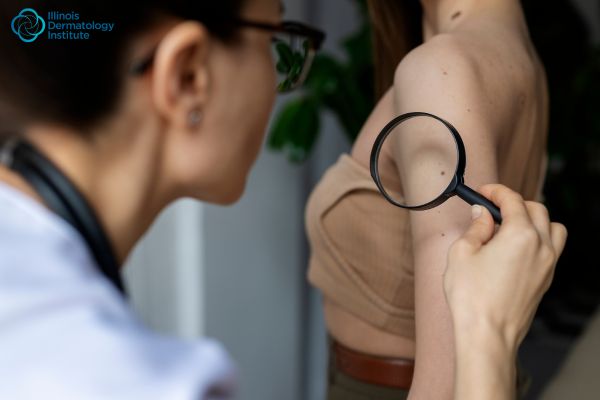
A dermatologist can usually diagnose actinic keratosis during a visual skin exam, sometimes using a handheld magnifier called a dermatoscope. If a spot looks unusual or does not respond to treatment as expected, a small biopsy may be taken to rule out skin cancer.
Treatment depends on how many lesions are present and where they sit. Common approaches include:
- Freezing individual lesions with liquid nitrogen, known as cryotherapy
- Prescription creams or gels that treat multiple or hard-to-see lesions across a wider area
- Photodynamic therapy, which pairs a light-sensitizing solution with a special light and suits areas with many lesions
The right option varies from person to person, and you can explore these treatments in more detail before a visit.
It is worth scheduling an evaluation for any patch that will not heal, and certain changes deserve prompt attention. A lesion that grows quickly, thickens or becomes firm, bleeds, turns painful or tender, or simply looks different from the spots around it should be checked without delay.
Prevention comes down to consistent habits. Daily broad-spectrum sunscreen of SPF 30 or higher, reapplied every two hours outdoors, along with sun-protective clothing, a wide-brimmed hat, shade during peak hours, and avoiding tanning beds, all help guard against sunburn and cumulative sun damage. Regular skin checks matter too, especially after a previous actinic keratosis.
When a Stubborn Patch Is Worth a Closer Look
A rough, dry patch that refuses to heal is worth a professional look, even when it seems minor. Actinic keratosis is common, it develops slowly, and it responds well to treatment when it is caught early. Acting sooner rather than later is less about fear and more about clarity, because a quick evaluation settles the real question, which spots actually matter and which ones do not.
The dermatologists at Illinois Dermatology Institute provide skin exams and actinic keratosis care at locations across Chicago, Northern Illinois, and Indiana. If you have noticed a stubborn patch that will not smooth out, you can schedule an evaluation with a provider near you.
FAQs
- Can actinic keratosis go away on its own?
Sometimes a lesion will flatten or fade for a while, but it often returns, and there is no way to know whether a given spot will clear, stay, or progress. Because of that uncertainty, actinic keratosis is best evaluated rather than left to resolve on its own.
- Is actinic keratosis contagious?
No. It is caused by cumulative sun exposure, not by a virus or bacteria, so it cannot be caught from or passed to another person through any kind of contact.
- Does actinic keratosis hurt?
Many spots are painless. Others may itch, sting, burn, feel tender, or catch on clothing and towels. A lack of pain does not mean a patch is harmless, which is why texture and persistence matter more than discomfort.
- How long does actinic keratosis take to turn into skin cancer?
Progression is slow and far from guaranteed, and most lesions never become cancer. When an actinic keratosis does progress to squamous cell carcinoma, the change tends to happen gradually, often over a period of years, which is part of why regular monitoring is so useful.
- What happens if actinic keratosis is left untreated?
Many lesions stay stable or come and go, but some thicken over time, and a portion can develop into squamous cell carcinoma. Untreated sun-damaged skin also tends to produce new lesions, so early treatment is usually simpler than waiting.
- Can you prevent actinic keratosis from coming back?
You can lower the odds with consistent sun protection, avoiding tanning beds, and routine skin checks. New lesions can still form in skin that already carries sun damage, so ongoing monitoring remains the most reliable safeguard.