5 Warning Signs Your Mole Should Be Checked by a Dermatologist
August 24, 2026
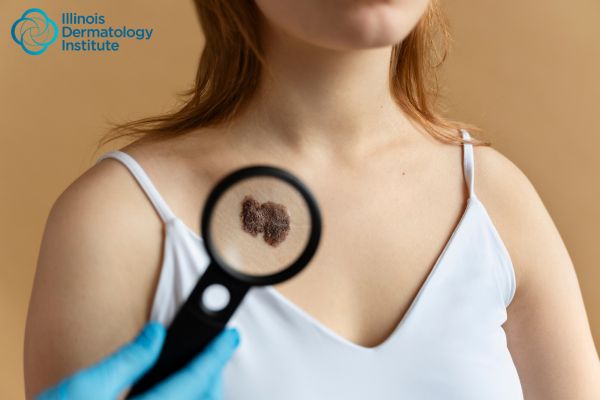
Most people have moles, they’re so common we rarely give them a second thought. But knowing how to tell the difference between a harmless spot and one that deserves a closer look could quite literally save your life.
Moles form when pigment-producing skin cells called melanocytes grow in clusters rather than spreading evenly across the skin. The vast majority are completely benign. But in some cases, a mole can become melanoma, one of the most dangerous forms of skin cancer. The good news: melanoma is also one of the most treatable cancers when it’s caught early.
Dermatologists use a well-established clinical framework called the ABCDE rule to evaluate moles, and the more patients understand it, the sooner potential problems get identified.
Below, we break down each warning sign, what to look for during a self-exam, and when it’s time to make an appointment.
What Does a Normal Mole Look Like?
Before identifying what’s concerning, it helps to understand what’s typical. A normal mole generally:
- Is round or oval with smooth, even edges
- Has a single, uniform color, usually tan, brown, or close to your skin tone
- Measures smaller than 6mm (roughly the diameter of a pencil eraser)
- Is flat or only slightly raised, with a consistent texture
- Remains essentially unchanged for years at a time
Most adults have somewhere between 10 and 40 moles on their body. Having a lot of moles isn’t inherently a problem, but knowing your baseline is what makes changes easier to notice.
The ABCDE Rule: How Dermatologists Evaluate Moles
The ABCDE framework was developed to give both clinicians and patients a reliable, easy-to-remember way to identify the early warning signs of melanoma. Each letter stands for a specific characteristic dermatologists look for when assessing whether a mole warrants concern.
Warning Sign #1 – Asymmetry
Mentally draw an imaginary line down the center of the mole. Do both halves mirror each other? They should.
What to look for: One half that looks noticeably different from the other in shape, size, or texture.
Why it matters: Healthy moles grow evenly in all directions. Asymmetry can be a sign of abnormal cell growth, cells multiplying more aggressively on one side than the other.
Warning Sign #2 – Border
The edges of a normal mole are clean and well-defined. Irregular borders are a red flag.
What to look for: Edges that appear ragged, notched, blurred, or that seem to fade or “bleed” into the surrounding skin rather than ending clearly.
Why it matters: Irregular borders can indicate the mole is growing in an uncontrolled way, expanding outward without a defined boundary.
Warning Sign #3 – Color
A healthy mole is one even shade. Variation in color within a single mole is something dermatologists take seriously.
What to look for: Multiple shades within the same mole, browns, blacks, reds, whites, or blues. Look for patches rather than a uniform tone throughout.
Why it matters: Color variation reflects uneven melanin distribution, which can be a sign that abnormal cells are present within the mole.
Warning Sign #4 – Diameter
Size isn’t everything, but it matters.
What to look for: A mole wider than 6mm, about the size of a standard pencil eraser. You can use a ruler to measure, or simply compare it visually.
Why it matters: Larger moles carry a statistically higher risk. More importantly, any mole that is
actively growing, regardless of its current size, deserves evaluation. Growth is the concern, not just the measurement at a single point in time.
Warning Sign #5 – Evolution
Of all the warning signs, this one may be the most important.
What to look for: Any change in a mole’s size, shape, color, elevation, or texture over time. Also watch for new symptoms: bleeding without being scratched, persistent itching, crusting, or tenderness.
Why it matters: Evolution applies even when a mole looks otherwise normal. A mole that is changing, in any way, is telling you something. If you look at a mole and think, “That looks different than it used to,” that’s enough reason to have it checked.
Beyond ABCDE: Other Symptoms That Shouldn’t Be Ignored
The ABCDE rule covers the most common warning signs, but melanoma and other skin concerns can sometimes present differently. Don’t wait to get evaluated if you notice:
- A new mole appearing after age 40
- A mole that bleeds spontaneously without being scratched or irritated
- Persistent itching or pain in or around a mole
- A mole that has become raised after previously being flat
- A dark streak appearing under a fingernail or toenail, known as subungual melanoma, this is a lesser-known but important presentation
- A sore near an existing mole that hasn’t healed within a few weeks
How to Do a Monthly Self-Exam
Self-exams won’t replace professional skin checks, but they’re one of the most effective habits you can build for early detection. Here’s how to do one thoroughly:
When: After a shower, in good lighting. Once a month is a solid routine.
What you need: A full-length mirror and a hand mirror for hard-to-see areas.
How to check:
- Start with your face, neck, scalp, and ears, use the hand mirror or have someone help with the scalp and the back of the neck.
- Move to your chest, torso, and arms, including underarms and between fingers.
- Check your back, buttocks, and the backs of your legs.
- Don’t skip less obvious spots: between your toes, the soles of your feet, and under your nails.
Tracking changes: Take photos of any moles you want to monitor. Comparing images from month to month makes evolution much easier to detect.
Who Is at Higher Risk for Melanoma?
Anyone can develop melanoma, but certain factors increase the risk significantly. You may be in a higher-risk category if you have:
- Fair skin, light eyes, or naturally light or red hair
- A history of blistering sunburns, especially during childhood or adolescence
- Frequent or prolonged UV exposure, including tanning bed use
- A family history of melanoma or skin cancer
- A personal history of any skin cancer
- 50 or more moles on your body
- Atypical or dysplastic moles (moles that are unusual in size, shape, or color)
- A weakened immune system
If several of these apply to you, annual professional full-body skin exams are strongly recommended, in addition to your monthly self-checks.
What to Expect During a Professional Mole Check
If you’ve never had a professional skin exam, here’s what the experience actually looks like, it’s far less intimidating than most people anticipate.
- A board-certified dermatologist will perform a full-body visual examination, which typically takes 15 to 30 minutes. The exam is non-invasive. The doctor may use a dermatoscope, a handheld magnifying device with a light source, to get a closer, more detailed look at any moles that catch their attention.
- If a mole appears suspicious, the dermatologist may recommend a biopsy: a small tissue sample is removed from the area and sent to a lab for analysis. The procedure is quick and done under local anesthetic. Results typically come back within a few days to a week.
- If the biopsy reveals anything abnormal, your dermatologist will walk you through the findings and discuss next steps. Most cases caught at an early stage are highly treatable.
When in Doubt, Get Checked
Remember the five warning signs: asymmetry, irregular borders, color variation, diameter over 6mm, and evolution. If you notice any of these changes, especially a mole that’s evolving, schedule a skin check with a dermatologist.
Most moles are harmless, but early detection makes a significant difference. Melanoma is highly treatable when found early, so don’t ignore a mole that looks different or has changed over time. Trust your instincts and get it checked.
Suspicious Mole? Get It Checked at Illinois Dermatology Institute
When it comes to moles and melanoma, early detection is everything, and a professional eye catches what a mirror can’t. At Illinois Dermatology Institute, our board-certified dermatologists perform thorough full-body skin exams, evaluate suspicious moles with clinical precision, and guide you through next steps if anything warrants a closer look.
Book an appointment today and get the peace of mind that comes with knowing your skin is in expert hands.
FAQs
- When should you be concerned about a mole?
If a mole shows any ABCDE signs, or bleeds, itches persistently, or has changed in any way, have it evaluated by a dermatologist.
- What does an abnormal mole look like?
An abnormal mole typically has uneven edges, multiple colors, an asymmetrical shape, or a size larger than a pencil eraser.
- How often should I get a mole check?
Once a year is recommended for most people, with more frequent exams for those with higher risk factors.
- Can a normal mole turn into melanoma?
Yes, though it’s uncommon, which is why regular full-body skin exams matter, not just monitoring known moles.
- Is it painful to have a mole biopsied?
No, the procedure is done under local anesthetic and most patients experience little to no discomfort.